蒙古青年论坛

 找回密码
 注册
查看: 3642|回复: 12

蒙古传统服装

[复制链接]
发表于 2008-11-1 10:42:07 | 显示全部楼层 |阅读模式
The traditional dress of the Mongols has a rich history spanning many centuries. It is closely connected with the Mongolian way of life and the country. The costumes are used in different situations; somebody rides on horseback over the steppe, he sits at home in his ger (yurt - round felt tent), or he dances at a national festival. The conditions of climate excert influence on the kind of dress, the costumes for the seasons of the year. In summer the Mongols wear a light coat or frock, the "Terleg" (Törlök - summer coat), in spring, autumn and winter a wadded coat (row cotton), the "Khovontei Deel", or a lambskin coat, the "Khurgan Dotortoi Deel", in winter they wear a sheepskin dress reminding of a fur coat, the "Tsagaan Nekhii Deel".

The Mongolian national costume is a robelike garment called a deel, that, like the Tibetan robe, has no pockets. The deel is worn with a thin silk sash several yards long tightly wound around the waist. Attached to the sash are essential objects such as the eating set, tinder pouch, snuff bottle, and tobacco and pipe pouches. Mongols, like the nomadic Tibetans and Manchurians, use an ingeniously designed eating set incorporating a sharp knife and a pair of chopsticks, and sometimes also includes a toothpick, ear scratcher, and a tweezer. They are made of precious metals and embellished with semi-precious stones.

The dress reflects the age of the wearer. The costumes of elderly people are, as a rule, modest and plain. The female dress shows differences between the attire of the girls and that of married women. The latter is decorated and adorned more splendidly with ornaments and jewellery. The design of the garments, the combination of colours as well as the decorative ornaments speak of an old tradition. The national costumes were mostly brown and dark blue. The Mongols wear the coat with the oblique border, the "Tashuu Engertei Deel", and the coat with the rectangular border, the "Durvuljin Engertei Deel". The materials from which the dresses were sewn were either produced by the people themselves, such as "leather, wool, and fur", or dresses have been made from silk, cotton, wool, and brocades and were richly decorated with jewellery and ornaments of gold, silver, corals, pearls, and precious stones. Every nationality has its own headdress (i.g. the "Toortsog", "Yuden", and "Zharantai"), hence there are many different kinds of caps and boots. The master (male or female) was able to glue, quilt, and stuff with wadding; he knew the symbolism of the ornaments used on the dresses, the symbolism of the colours and their combination.


- see more about Ornaments -
Ornaments of the Turk-Mongolian tribe

The largest group, the Khalkha, lives in Central and Eastern Mongolia; the Bayad, the Durvud, the Khoton, the Altai-Uriankhai, the Torguud, the Uuld, the Zakhchin and the Myangad live in the West; in Eastern Mongolia live the Dariganga, the Barga, the Uzemchin, the Buryat and the Khamnigan, and in the North the Khotgoid, the Darkhad, the Khuvsgul-Uriankhai, the Tsaatan and the Khakhar. Also the Kazakhs, who are Muslims, live in the Altai.There are more than 20 tribes of Mongol or Turk origin living in Mongolia !

Below you find enlargements of map sections – do click on these and enjoy the view!
© Ganna & Albi - Bi-Bid & Face Music 2006


Kazakh

West Mongolia
High Altai


Sumer


Zakhchin (Dzakhchin),

South-West Mongolia
Gobi Altai
Oirad tribe


Winter


Winter


Altai Uriankhai
(Altai Uryankhai)

West Mongolia
Oirad tribe


Winter


Winter


Myangat (Mingat)

West Mongolia
Gobi Altai
Oirad tribe


Winter


Bayad, Torguud (Torgut)

North-West Mongolia
Oirad tribe


Bayad


Bayad

Bayad


Torguud (summer)


Khoton (Khotan)

North-West Mongolia
Turk tribe (Uighur)


Summer


Durvud (Dörbet)

North-West Mongolia
Oirad tribe


Uuld (Ölöt)

West Mongolia
Oirad tribe


Khuvsgul-Uriankhai
(Chöwsgöl-Uryankhai)


North Mongolia


Tsaatan

Noth Mongolia
Turk tribe


Buryat (Buriad)

North Mongolia
North-
East Mongolia


Winter


Summer


Kalkha

Central Mongolia


Summer


Winter


Winter


Toortsog (Tortsog)
(Winter)

Yuden
(Winter)


Üzemchin, Dariganga,
Darkhad (Darkhat)

East Mongolia
and Inner Mongolia


Üzemchin

Dariganga (summer)


Darkhad (winter)

Barga,

South-East Mongolia
and Inner Mongolia


Barga (winter)


Zharantai / Jarantai (winter) 1
2
3
4
5
6
7
8
9
10
11
12
13
14
15
16
17
18
19
20

Dorbet (summer)

21
22
23

Lkham - Käli
(tsam)

Lkham - Käli

Jamsran (tsam)

Bokh (wrestler)
Zodog shuudag
(Dsodok)
(Costume)

发表于 2008-11-1 11:53:15 | 显示全部楼层
Fantastic!

Mongols like to wear nice, richly decorated clothes which compensate the simple, ascetic nomadic lifestyle. A harsh climate and uneasy life demand attention to the  smallest details of clothing. The nomads' wardrobe is compact but has many variations available for different purposes.
The De-el or a long textile gown forms the basis of almost all Mongolian clothes. Beside being a main cloth, it can serve as a blanket, tent and cover against unwanted glances. Depending on weather or work needs, other pieces such as jacket or coat can supplement the de-el.
De-el protects perfectly against cold and winds. If necessary, its long sleeves are rolled down to serve as gloves. Wide sash, made of several meters long textile, serves as a corset protecting against severe shaking during a fast horse ride. It also serves as a hanger to which a knife, firestone, cup and other accessories can be attached.      
A pocket formed by de-el above the sash, makes an ideal place for keeping small items. In the nomadic culture, special attention was given to the quality of clothes and its tidiness since a missing button, undone seam or loose knot could have cost one's life during a sudden snow storm or fast horse ride.

Share Mongol culture!
发表于 2008-11-1 18:15:55 | 显示全部楼层
既然开了这样的帖子,楼主就一直把这个帖子完成吧!
弄一个大全似的帖子哦!
 楼主| 发表于 2008-11-2 20:31:28 | 显示全部楼层
我只是偶尔有空的时候搜索到什么就顺手贴上来,系统性的工作还没想过
发表于 2008-11-23 00:09:29 | 显示全部楼层
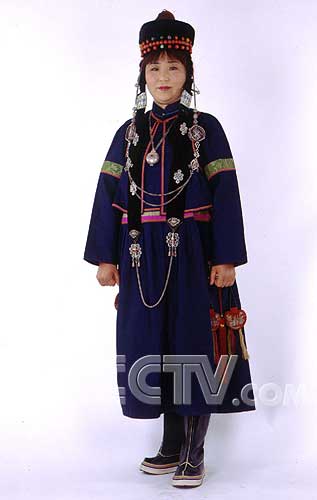
布里亚特蒙古妇女服饰
发表于 2008-11-23 00:26:08 | 显示全部楼层
Clothing in Mongolia, Mongolia
Skillful wayfarerSkillful wayfarerSkillful wayfarer Mazoto Kyio
Rating 3/5Rating: 3.41 out of 5.00. 17 members have rated this tip
Displayed: 3944  times.

The del is the Mongols' traditional garment worn on both workdays and special days. It is a long, loose gown cut in one piece with the sleeves; it has a high collar and widely overlaps at the front. The del is girdled with a sash.

Each ethnic group living in Mongolia has its own del distinguished by cut, colour and trimming. The distinctions go unnoticed by foreigners, yet for the Mongols they are obvious.

Before the revolution, all social strata in Mongolia had their own manner of dressing. Livestock-breeders, for example, wore plain dels, which served them both summer and winter. The priests wore yellow dels with a cape or khimj, thrown over it. Secular feudal lords put on smart hats and silk waistcoats.

Today, townspeople tend to wear European-style clothes. In the countryside, however, the modern attire is inconvenient and impractical. The del has several uses – as a coat, as a blanket, and as means of concealing yourself when going to the toilet on the open steppe. In the cities, as people start aging, especially the women, begin to appreciate the advantages of the del and wear it, trying to excel each other in the choice of fabric, as well as in the elegance of the cut and originality of the trimmings.

Commonly there are three varieties of del, each for a particular season. The first, the dan del, is very much like a dress, a frock cut in one piece from plain cloth without padding. Rural women wear dan dels all year around. In cold weather they put on warm clothes over them. Terleg is a slightly padded del. And finally the winter del is padded with sheepskin or cotton wool.

Dels for men and women are of the same cut. The difference is that male dels are wider and of more demure colours. The pattern is simple enough. The sleeves are cut together with the gown and there are only a few minor details. Moreover the tailor does not have to worry about the precise length and width.

Measurements are usually made using the hand rather than a tape measure. The 'too' is the distance between the thumb and the middle finger, the 'soom' the distance between the thumb and the forefinger and the 'khuruu' the length of the forefinger.

The del for everyday wear is grey, brown or some other dark colour, while the holiday del is a bright blue, green or claret silk with a silk sash of contrasting colour several metres long. The sash is not simply an adornment. It also serves as a soft corset facilitating long rides on horseback. In days gone by, men would attach a sheathed knife, a tobacco pouch, a flint and a pipe-cleaning hook to the belt. Characteristically, the Mongol always hid his pipe in his boots.

The del collar, breasts and sleeves are trimmed with leather and colour brocade tape, which can be wide or narrow depending on the wearer's taste. The del buttons, if they are not commercially produced from decorative stones or silver, are narrow strips of cloth tied into intricate knots.

Traditional dels are normally seen now only at concerts or official occasions.

In addition to the del is the jacket known as a khurim. In cold weather it is put on over the del. The gutal is the high boot made from unbending leather and lined with fine and thin felt. They are decorated with different designs. Both the left and right are traditionally the same shape and were worn with thick socks made from quilted cloth. Traditional boots are without heels and have turned up toes. Mongolian hats are still very much the normal attire in the countryside. The traditional hat is a hat for all seasons trimmed with fur, fox fur in most cases. The sides of the hat can be tied down to keep the ears warm or tied on top in the warmer periods. The hats are worn by both men and by women. In the past, headgear was worn to show social status. The design is also symbolic. The pointed top of the hat represents Mount Sumber, the legendary land of the Mongol forefathers. The knot on the top represents the unity of the nation, red ribbons are the sun's rays and the broad brim represents the country's inaccessibility.

Because of the different ethnic groups residing in Mongolia, there are distinctions in the way they all dress. Therefore it is estimated that between them all, there are about 400 different types of garments, 20 boots, 10 sashes and 20 types of hats. Source: www.mongoliatourism.gov.mn
发表于 2008-11-23 00:27:55 | 显示全部楼层
发表于 2008-11-23 00:28:23 | 显示全部楼层
发表于 2008-11-23 00:28:56 | 显示全部楼层
发表于 2008-11-23 00:30:34 | 显示全部楼层
Khubilai queen . Her hat is also interesting.
发表于 2008-11-23 00:31:35 | 显示全部楼层
发表于 2008-11-23 02:49:07 | 显示全部楼层

Horcin


[ 本帖最后由 litkt 于 2008-12-1 15:40 编辑 ]

本帖子中包含更多资源

您需要 登录 才可以下载或查看,没有账号?注册

x
发表于 2008-11-23 09:40:42 | 显示全部楼层
MGL Uliin Gazriin zurag deer Barga Uzemchin hoyriin bairshil sologdsan baina.
您需要登录后才可以回帖 登录 | 注册

本版积分规则

Archiver|手机版|小黑屋|蒙古青年论坛

GMT+8, 2026-7-25 06:33 , Processed in 0.015589 second(s), 15 queries .

Powered by Discuz! X3.4

© 2001-2023 Discuz! Team.

快速回复 返回顶部 返回列表